
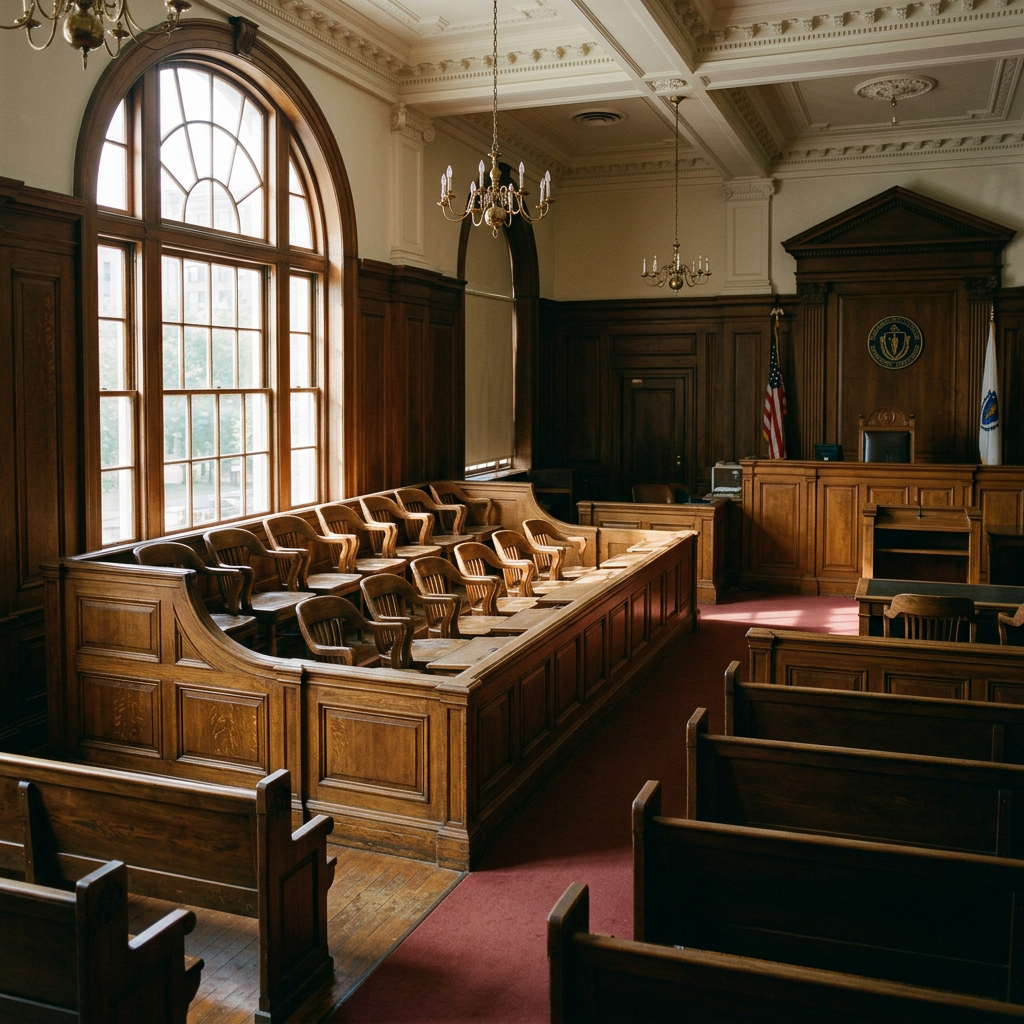
A criminal trial in Massachusetts follows a formal, multi-stage process designed to protect defendants’ rights while requiring the Commonwealth to prove guilt beyond a reasonable doubt. In another blog post, I talked about the hearings that take place before a trial. Today, let’s talk about what to expect if your case goes to trial.
As I mentioned in the other blog post, you have the right to a trial by jury, but can also choose to have a “bench” trial where the judge alone decides if you were proven guilty. I will limit myself here to jury trials, which (in my opinion) are usually the better option for a defendant.
Forget about the trials you may have seen in lawyer shows on TV. Real trials rarely have spectators in the audience. Real trials rarely, if ever, have dramatic confessions by witnesses. Real trials can be pretty dull, compared to TV shows.
The first day of the trial, before the jurors get called into the room, the judge will usually ask the lawyers if they have any pre-trial motions or other issues they want to bring up. For example, a defense lawyer may anticipate that the prosecutor will offer evidence which might not be admissible, such as evidence of the defendant being charged with a similar crime two years earlier. The defense lawyer may ask the judge to rule before the trial begins that the prosecutor cannot even mention such evidence, never mind put the evidence into the record.
After the judge decides any pre-trial issues, the next step is usually jury selection. All members of the jury pool get called into the room. The prosecutor and the defendant get to read every juror’s biographical questionnaire. They will try to identify people who they do or do not want on the jury. The judge will call jurors to come forward, one by one. The prosecutor and the defense lawyer can challenge any juror who they believe would not be impartial, but the judge will decide if that person is able to serve. Once a full jury is seated, each side then gets two “peremptory” challenges. A peremptory challenge is where either side can have a person removed from the jury, without having to explain why. If any juror gets excluded by a peremptory challenge, the judge will call additional members of the jury pool to serve.
Once there is a jury, the trial begins with opening statements from each lawyer, summarizing what they expect the evidence to show. The prosecutor then presents the Commonwealth’s case. The Commonwealth’s witnesses typically include police officers, the alleged victim, and, in some cases, an expert witness. Once the Commonwealth has presented all its evidence, the defendant has the option to present his or her case. However, a defendant is not required to call witnesses or present a defense, because only the Commonwealth has the burden of proof at a criminal trial. Any witness who testifies for either side is subject to direct examination, where the lawyer who called them asks the questions, and cross-examination, where the opposing lawyer asks questions. The system is not perfect, but having a witness answer questions from both sides usually gives the jury a good opportunity to figure out who is telling the truth. Throughout the trial, strict rules of evidence apply, and defendants maintain the right to remain silent, as the burden of proof always rests with the prosecution.
After all the testimony and exhibits are in the record, the next step is usually the closing arguments. Each side gets an opportunity to argue to the jury why they should find the defendant guilty, or not guilty. From a lawyer’s point of view, closing arguments are often the most important moment in the trial. After closing arguments, the judge will instruct the jury on the law. Jury instructions typically include an explanation of the “elements” of the charged offense, meaning the specific facts the Commonwealth has to prove in order to prove the defendant is guilty. Jury instructions also typically address what evidence the jury may or may not consider (for example, the jury can’t do their own Internet searches to look for evidence that was not brought up during the trial).
After instructing the jury, the judge will then send the jury to a separate room to deliberate, meaning to talk among themselves until they reach a unanimous verdict. The moment in a trial that is usually closest to the drama you see on TV is when the jury announces that they have a verdict. Everybody has to come back into the courtroom. There is complete silence while waiting to hear what the jury has decided. The defendant’s life is in the hands of total strangers, and there is nothing he or she can do about it.
If a defendant is found not guilty, they are immediately released. If he or she is convicted, sentencing may occur right away (for misdemeanors) or be scheduled for a later date (for felonies). Understanding each step of this process can help defendants and families better prepare for what can be an intense and highly structured legal experience.
Here are a few final thoughts. As frustrating as it is, trials often get rescheduled on the day that everyone shows up. Other times, trials don’t happen because at the last minute the two sides reach a plea agreement. Never make plans for the day after the scheduled trial date. The jury might take a long time to decide, in which case the trial keeps going until there is a verdict. Like a baseball game, a trial doesn’t end until somebody comes out ahead.